Overview
Most welding jobs start with a simple problem: something cracked, something wore out, or something needs to be built that you cannot buy off the shelf. The hard part is usually explaining the job so the right person can quote it properly. This guide walks through the main kinds of welding and fabrication work we do in Calgary and the surrounding area, how to tell which one your project falls under, and what information helps you get an accurate answer quickly.
Repair, fabrication or on-site work?
Nearly every request fits into one of three groups. Knowing which one you are in makes the first conversation much shorter.
- Repairs restore something that already exists: a cracked trailer frame, a worn excavator bucket, a leaking aluminum tank or a broken bracket. The goal is to bring the part back to service, ideally stronger than before.
- Fabrication means building something new from raw material, such as railings, stairs, gates, beams, skids or a custom part made to your drawing or measurements.
- On-site work covers both repairs and installation when the item is too large, too heavy or too busy to bring to a shop. Equipment in the field, steel on a construction site and fixed structures usually fall here.
Common services and where to read more
The table below groups the work we handle by the type of job. Each link goes to a page with more detail on that service.
| Type of job | Typical examples | Learn more |
|---|---|---|
| Mobile and on-site welding | Field repairs, construction-site welding, emergency breakdowns | Mobile welding repair, portable welding services |
| Heavy equipment | Excavator and loader buckets, hard facing, waffling, structural cracks | Heavy equipment welding and repair |
| Trailers and transport | Frames, hitches, cross members, aluminum decks | Trailer welding and repair |
| Aluminum and stainless steel | Repairs and fabrication in non-ferrous and corrosion-resistant metals | Aluminum welding, stainless steel welding |
| Fuel tanks | Cracked or leaking aluminum diesel tanks | Aluminum fuel tank repair |
| Pressure and industrial | B pressure welding, process piping, pressure vessels, skid packages | B pressure welding, process piping, pressure vessels, skid packages |
| Oilfield and rig work | Welding on and around drilling and service rigs | Rig welding services |
| Structural steel | Beams, columns, trusses and new construction | Structural beam, column and truss fabrication, new construction welding |
| Custom metalwork | Railings, stairs, ramps, gates and fences | Custom gates, railings and stairs |
For the full list in one place, see our welding and fabrication services overview.
Which welding process does your job need?
You do not need to choose a welding process yourself, but it helps to know why a welder might recommend one over another. The main factors are the metal, its thickness, where the work happens and how the finished weld will be loaded.
- MIG (GMAW) is fast and clean on steel, stainless and aluminum, and works best indoors. See what GMAW welding is.
- TIG (GTAW) gives the most control on thin material, stainless and aluminum where appearance matters. Our GTAW TIG welding guide explains why.
- Stick (SMAW) handles wind, dirty steel and thick sections well, which is why it is common for field repairs. Read the SMAW stick welding guide.
- Flux-cored (FCAW) deposits a lot of metal quickly and is popular for structural and heavy equipment work. See our flux core arc welding guide.
Shop or on site?
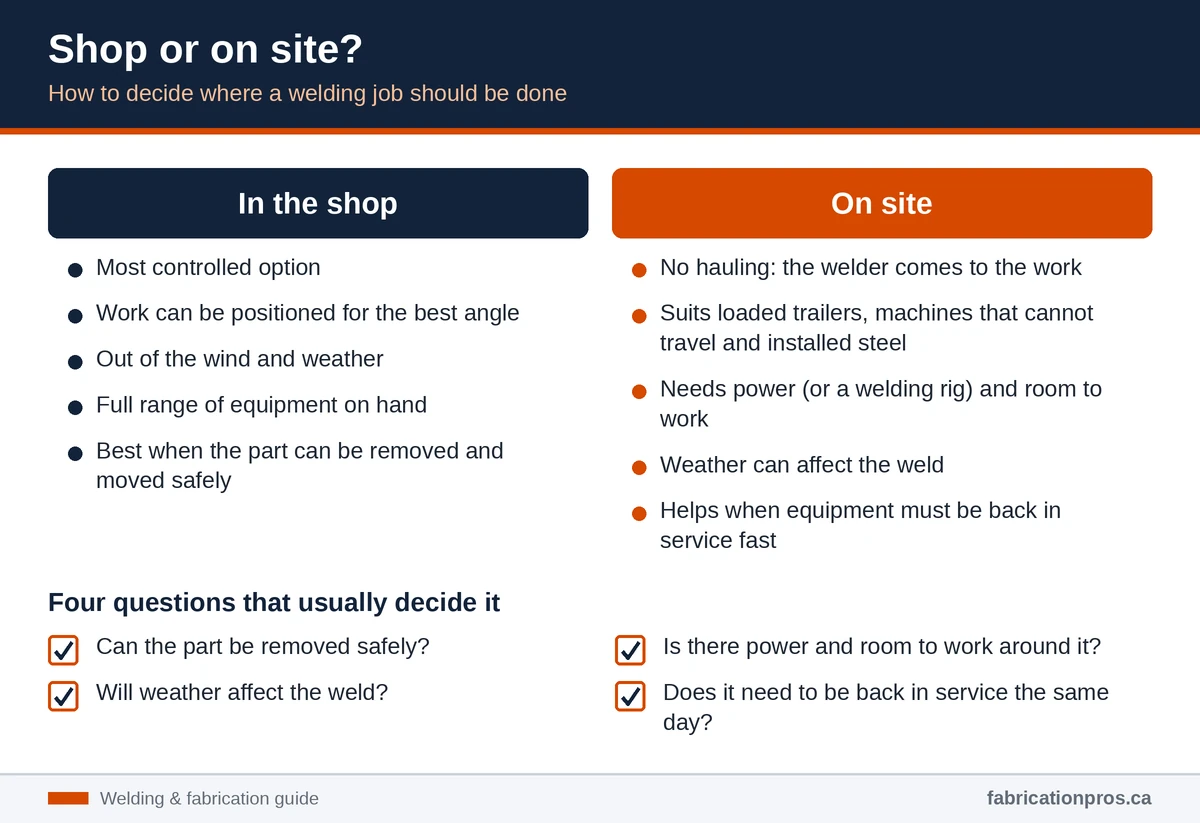
Bringing a part to the shop is usually the most controlled option. The welder can position the work for the best angle, keep it out of the wind and use the full range of equipment. On-site work makes more sense when moving the item would cost more time or money than the repair itself, for example a loaded trailer, a machine that cannot travel, or steel that is already installed.
A few questions decide it: Can the part be removed safely? Is there power and room to work around it? Will weather affect the weld? Does the equipment need to be back in service the same day? If you are not sure, describe the situation and we can suggest the better option.
What to send when you ask for a quote
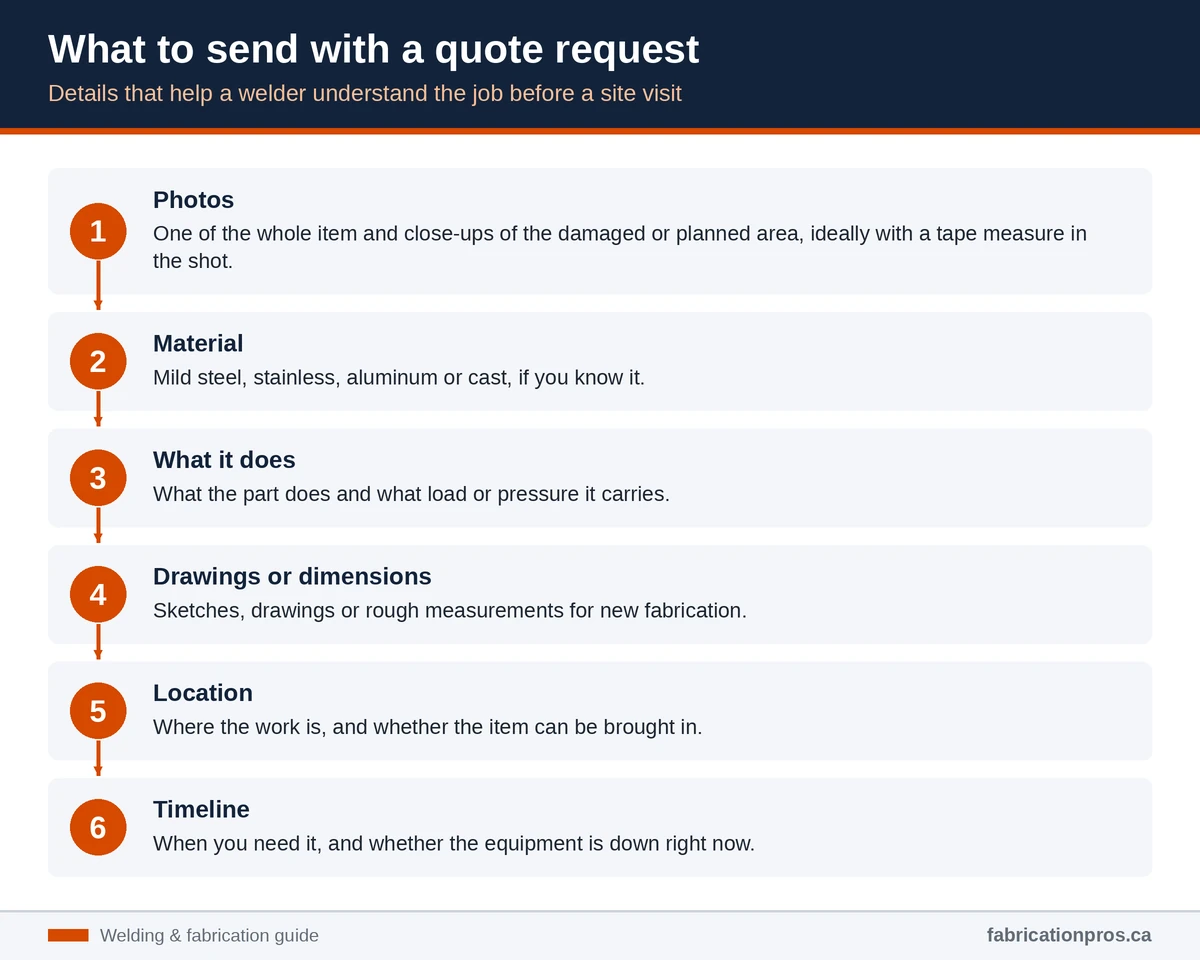
A clear request saves a site visit in many cases. These details help us understand the job before anyone picks up a torch:
- Several photos: one of the whole item and close-ups of the damaged or planned area, ideally with a tape measure in the shot
- The material, if you know it (mild steel, stainless, aluminum or cast)
- What the part does and what load or pressure it carries
- Drawings, sketches or rough dimensions for new fabrication
- Where the work is, and whether the item can be brought in
- Your timeline, and whether the equipment is down right now
Questions worth asking any welding shop
- Have you repaired or built this type of item before?
- Which process and filler metal do you plan to use, and why?
- Will the area be cleaned, ground or bevelled before welding?
- Does the job need any certification, inspection or documentation?
- Can the work be done in the shop, or does it need to be done on site?
A good welder will be happy to explain the plan in plain language. If a repair is not worth doing, they should tell you that too. Our article on whether to repair or replace a worn excavator bucket is a good example of how that decision is made.
Welding in a Calgary climate
Local conditions affect welding more than people expect. Cold steel pulls heat out of a weld quickly, so thicker parts often need preheating in winter to avoid cracking. Snow, frost and condensation have to be dried off the joint first. Road salt and gravel are hard on trailers and truck equipment, which is why spring is a common time to find cracked cross members and rusted mounts. Planning repairs before the busy construction season can also save waiting time.
Talk to us about your project
Whether you need a quick repair, a custom part or a crew on site, Fabrication Pros can help you figure out the next step. Visit the Fabrication Pros homepage to see more of our work, or contact us to request a quote.
Contact us with any questions you may have.