Mon – Sat: 7:00am – 6:00pm

Posts by Boss

A Quick Guide to SMAW (Stick Welding): How It Works, Best Practices, Electrode Types, and Common Applications

A Quick Guide to SMAW (Stick Welding)

In Calgary’s industrial, construction, and repair sectors, few welding processes are as reliable and versatile as SMAW—Shielded Metal Arc Welding, commonly known as stick welding. Whether you’re working on heavy equipment, structural steel, pipelines, farm machinery, or on-site repairs in difficult conditions, SMAW remains one of the most trusted welding methods in Alberta.

This comprehensive guide explores how SMAW works, best practices for strong structural welds, the most common electrode types, polarity differences, and where stick welding is used across Calgary’s residential, commercial, and industrial markets.


What Is SMAW (Stick Welding)?

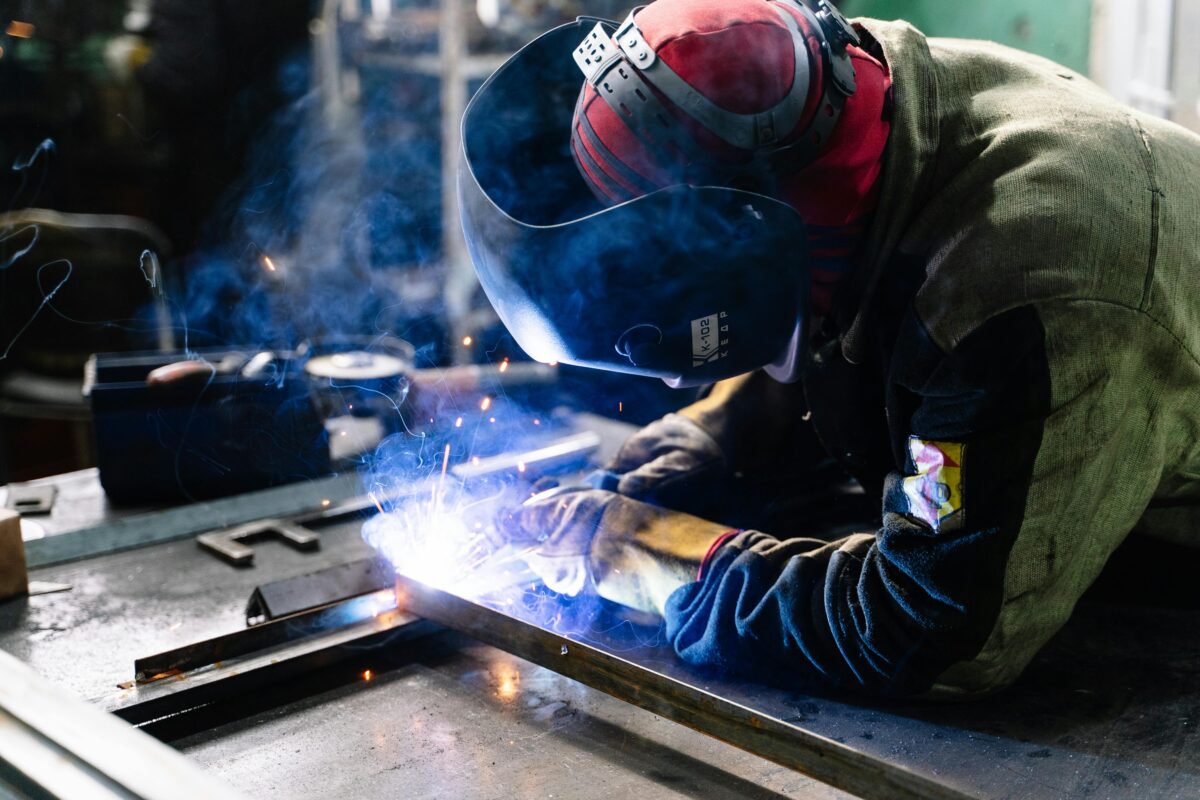
SMAW (Shielded Metal Arc Welding) is a manual welding process that uses a flux-coated consumable electrode, commonly called a “stick rod.”
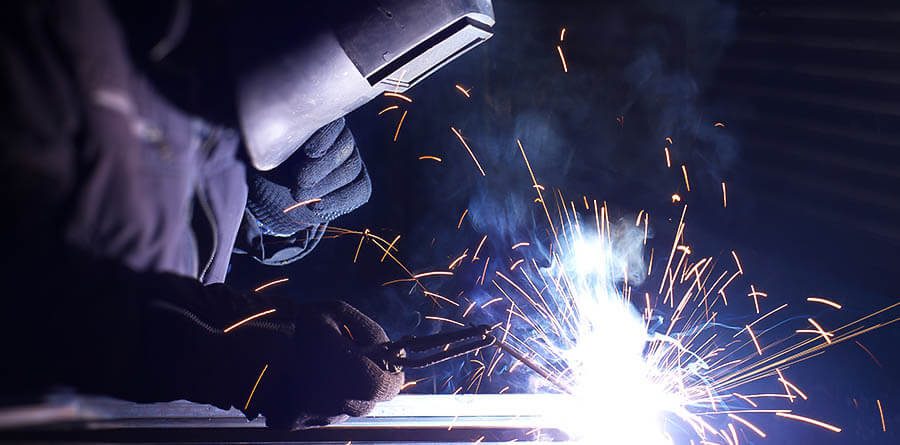
When the rod strikes the metal, it creates an electric arc that melts both the base metal and the electrode, forming a strong weld pool.

The key advantage of SMAW is that it does not require external shielding gas. Instead, the electrode’s flux coating releases gases and forms a protective slag that shields the weld from atmospheric contamination.

This makes stick welding extremely useful in locations where MIG or TIG welding cannot be used, such as:

  • Outdoor worksites
  • Windy conditions
  • Dirty environments
  • Remote areas
  • Industrial shutdown work

Why Stick Welding Is So Popular

Calgary’s diverse industries—including oil & gas, construction, heavy equipment, agricultural operations, manufacturing, and fabrication shops—rely heavily on SMAW because of its:

Versatility

Works on steel, cast iron, stainless steel, hardfacing, pipelines, and heavy structural components.

Portability

Only requires a welding machine and rods—no gas cylinders, hoses, or wire feeders.

Performance Outdoors

Handles wind, moisture, and dirt much better than TIG or MIG.

Deep Penetration

Many SMAW electrodes deliver strong, structural-grade penetration ideal for heavy steel.

Cost-Efficiency

Equipment setup is simple, inexpensive, and easy to maintain.


How SMAW (Stick Welding) Works

Stick welding is simple in concept but requires skill, technique, and electrode knowledge to master. Here’s how the SMAW process works:


1. Power Source & Polarity

SMAW uses either:

  • AC (alternating current)
  • DCEP (direct current electrode positive)
  • DCEN (direct current electrode negative)

Electrode type determines the correct polarity. Rods like 7018 typically use DCEP, while rods like 6013 and 6011 may use AC or DC.

Correct polarity affects:

  • Arc stability
  • Penetration
  • Weld bead appearance
  • Spatter levels

2. Striking the Arc

The welder starts the arc using:

  • A tap technique, or
  • A scratch technique (like striking a match)

Once the arc starts, the rod and base metal melt into a controlled weld puddle.


3. Flux Coating Activation

The flux coating burns and produces:

  • Shielding gas → protects molten metal
  • Slag layer → solidifies on top of the weld
  • Arc stabilizers → regulate arc performance
  • Alloying elements → improve weld metal strength

This self-shielding feature is what makes SMAW ideal for outdoor and remote locations.


4. Weld Pool Formation

As the rod melts, it adds filler metal to the joint. The welder controls:

  • Rod angle
  • Travel speed
  • Arc length
  • Heat input
  • Puddle size

Proper technique creates a smooth, strong weld.


5. Slag Removal

Once the weld cools slightly, the slag is removed with:

  • A chipping hammer
  • A wire brush

Removing slag reveals the finished bead and prepares the surface for additional weld passes.


Best Practices for Strong, Clean SMAW Welds

Professional welders follow strict techniques to ensure structural integrity and aesthetic weld quality:

🔧 Maintain the right arc length

Too long → spatter, undercut, porosity
Too short → sticking, unstable arc

🔧 Use the correct rod angle

Typically 10–15° drag angle depending on joint type.

🔧 Control travel speed

Slow = excessive buildup
Fast = poor penetration

🔧 Keep electrodes dry

Moisture causes porosity and hydrogen cracking.
Rods like 7018 should be stored in a rod oven.

🔧 Prep the metal properly

Although SMAW tolerates dirt better than TIG/MIG, cleaner metal always results in stronger welds.

🔧 Match amperage to the rod diameter

Example amperage ranges:

  • 1/8″ 7018: 90–140 amps
  • 1/8″ 6010: 70–120 amps

Common SMAW Electrode Types and Their Applications

SMAW rods vary widely in performance. Here are the most common electrodes used in Calgary fabrication and repair work:


E6010 – Deep Penetrating Pipe & Root Pass Rod

Good for:

  • Root passes
  • Pipeline welding
  • Dirty, rusty metal
  • Out-of-position welding

Advantages:

  • Fast-freeze puddle
  • High penetration
  • Great for vertical and overhead

E6011 – AC-Compatible Version of 6010

Good for:

  • Farm equipment
  • Maintenance welding
  • Sheet metal repairs
  • AC welders

Advantages:

  • Works on AC machines
  • Good for beginners
  • Great on dirty steel

E6013 – Smooth, Clean Beads

Common uses:

  • General fabrication
  • Thin metal
  • Fencing
  • Automotive sheet metal

Advantages:

  • Soft, stable arc
  • Minimal spatter
  • Cleaner weld appearance

E7018 – Low Hydrogen Structural Rod

The most popular rod in Calgary construction.
Used for:

  • Structural steel
  • Heavy equipment
  • Buildings and bridges
  • High-strength applications
  • Pressure vessels

Advantages:

  • Smooth bead profile
  • Strong, low-hydrogen weld
  • Excellent for critical welds

Note: Must be kept dry—requires rod oven storage.


E7024 – High-Deposition Iron Powder Rod

Used for:

  • Long flat welds
  • Fillet welds
  • High-production work

Advantages:

  • Extremely high deposition rate
  • Heavy, smooth weld beads

Common Applications of Stick Welding

SMAW is used daily across Calgary’s trades, fabrication shops, and industrial operations because it excels where other processes struggle.


1. Heavy Equipment Repair

Ideal for:

  • Excavator buckets
  • Loader arms
  • Dozer blades
  • Frames and booms
  • Hardfacing applications

SMAW’s penetration and outdoor reliability make it perfect for field repairs.


2. Oil & Gas and Pipeline Work

Stick welding is a standard in Alberta’s energy sector for:

  • Pipeline construction
  • Station repairs
  • Pressure piping
  • Facility maintenance

Rods like 6010 and 7018 dominate this category.


3. Structural Steel and Construction

Used for:

  • I-beams
  • Columns
  • Stair stringers
  • Support frames
  • Building erection

Low-hydrogen rods provide the strength required for engineered steel structures.


4. Fabrication & Manufacturing

Stick welding is useful in shop environments for:

  • Brackets
  • Heavy frames
  • Machinery bases
  • Industrial components

5. Farm, Ranch, and Rural Welding

Perfect for:

  • Fencing
  • Implements
  • Trailers
  • Gates
  • Repair work

SMAW is reliable even in mud, wind, and low-visibility environments.


6. Cast Iron Welding

Specialized electrodes allow stick welding to repair:

  • Engine blocks
  • Machinery housings
  • Brackets and mounts

Why Calgary Businesses Trust SMAW Welding Services

SMAW remains a cornerstone of welding because it offers:

  • Strong, deep penetrating welds
  • Excellent performance outdoors
  • Versatility for multiple metals
  • Highly portable equipment
  • Cost-effective, dependable repairs

For heavy-duty work where reliability matters, stick welding is still one of the most trusted welding processes available.


Need SMAW Welding Services in Calgary? We’re Here to Help

Whether you’re dealing with:

  • Structural welding
  • Heavy equipment repairs
  • On-site field welding
  • Farm machinery repairs
  • Industrial maintenance
  • Pipeline work
  • Stick welding fabrication

Professional SMAW services ensure your steel structures and equipment receive durable, code-compliant welds that last.

    Read more

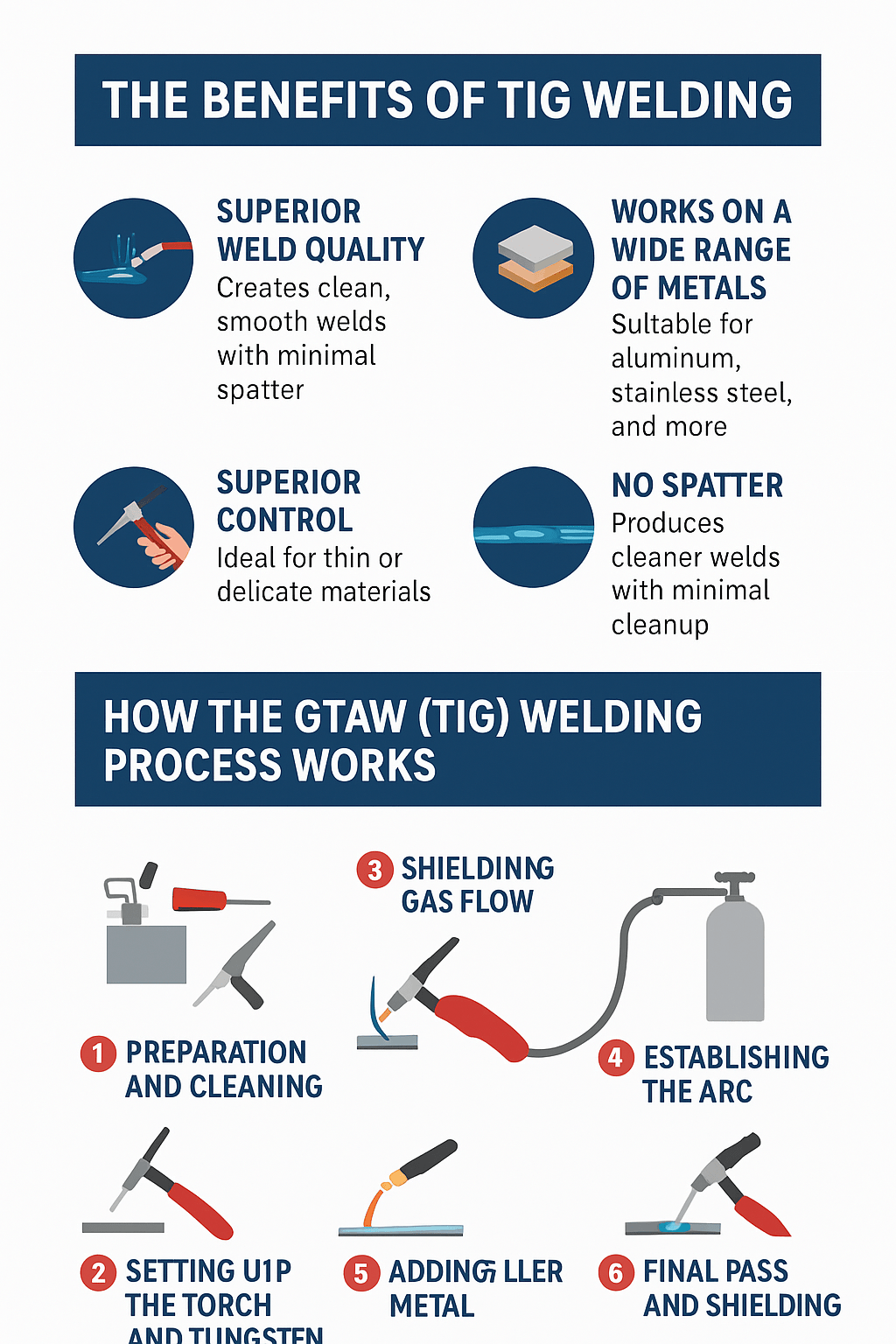
    The Benefits of TIG Welding and How the GTAW Process Works – Calgary’s Trusted Welding Experts Explain

    TIG Welding and How the GTAW Process Works

    When precision, strength, and clean weld aesthetics matter, few welding processes compare to TIG welding, also known as GTAW (Gas Tungsten Arc Welding). At Fabrication Pros here in Calgary, Alberta, TIG welding is one of the core services we provide for residential, commercial, and industrial clients. From aluminum repairs to stainless steel fabrication, TIG welding delivers unmatched quality — and our certified welders use it daily on projects requiring the highest level of craftsmanship.

    In this guide, we’ll break down the benefits of TIG welding and explain the GTAW process step-by-step, so you understand exactly why this method is trusted across Alberta’s industries.


    What Is TIG Welding (GTAW)?

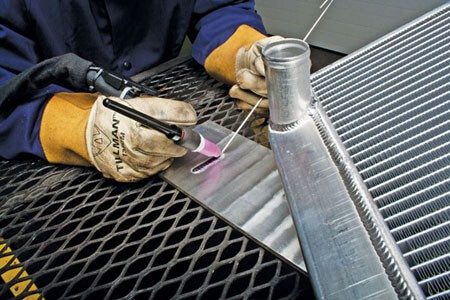
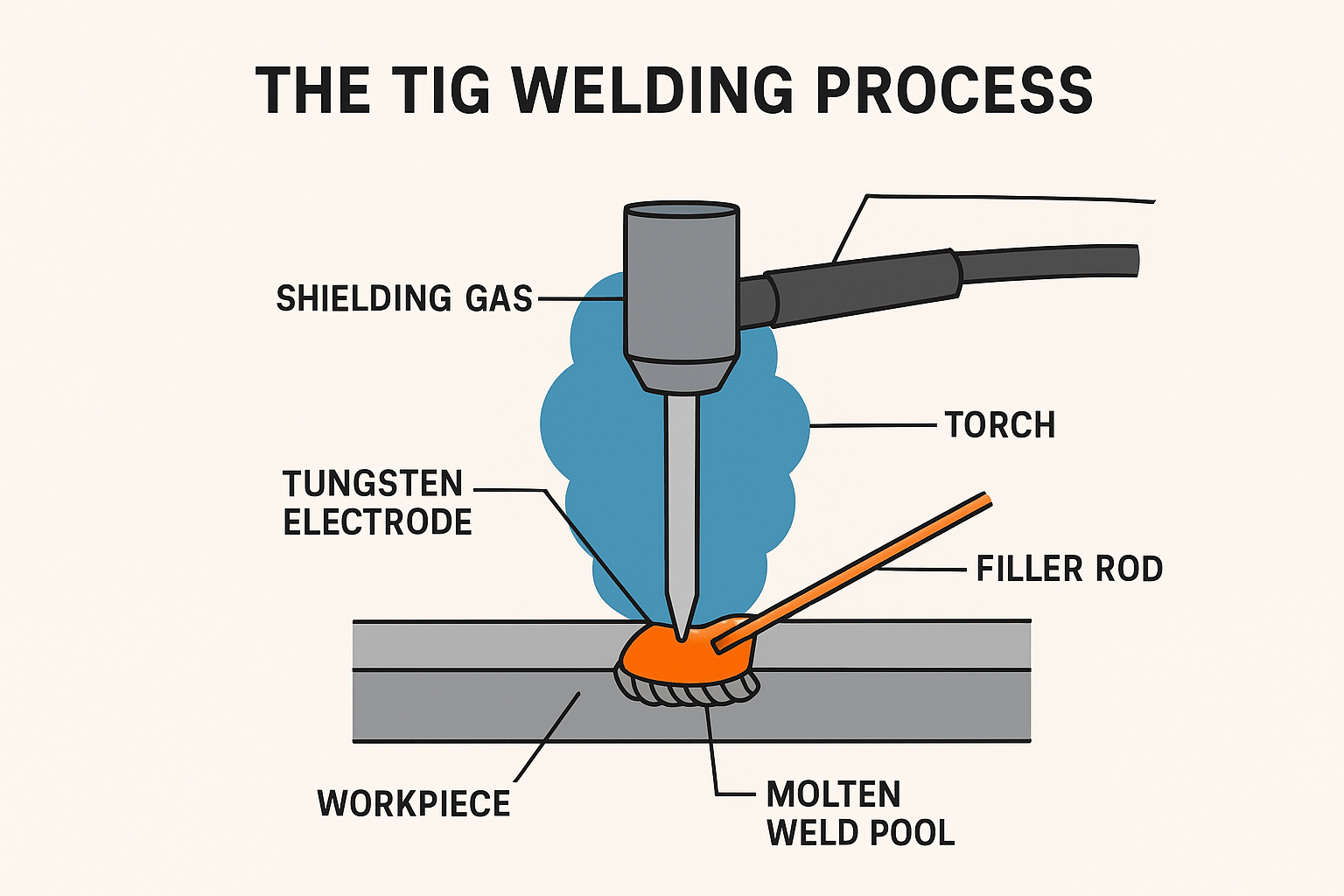
    TIG welding, or Gas Tungsten Arc Welding, is a process that uses a non-consumable tungsten electrode to create an arc that melts the base metal. Instead of the electrode melting (like in MIG or stick welding), the welder controls the weld puddle and adds filler metal manually when needed.

    A shielding gas — most commonly argon — protects the weld area from contamination and oxidation.

    Because of this high level of control, TIG welding produces the cleanest, strongest, and most precise welds in the industry.


    The Benefits of TIG Welding for Calgary Welding Shop Projects

    1. Superior Weld Quality

    TIG welding creates:

    • Clean, smooth bead appearance
    • Minimal spatter
    • Strong, durable welds
    • High aesthetic appeal

    This makes TIG the preferred choice for aluminum tanks, stainless steel components, ornamental metalwork, and precision fabrication.


    2. Works on a Wide Range of Metals

    TIG welding is extremely versatile. It can be used on:

    This flexibility allows our Calgary welding shop to take on everything from industrial repairs to automotive parts, brewery equipment, and custom fabrication.


    3. Superior Control for Thin or Delicate Material

    Unlike MIG or Stick welding, which can easily burn through thin metal, TIG is ideal for precision applications. Our welders can create strong welds on thin aluminum, stainless steel tubing, or lightweight components without distortion.


    4. No Spatter and Minimal Cleanup

    Because filler metal is added manually and the electrode doesn’t melt, TIG welding produces:

    • Zero slag
    • Zero spatter
    • Minimal cleanup
    • Cleaner finishes for painted or polished surfaces

    In decorative or food-grade applications, this is a major advantage.


    5. Stronger, More Reliable Welds

    TIG welding is known for producing:

    • Deep penetration
    • Strong fusion
    • Consistent structural integrity

    This is why industries like aerospace, oil and gas, agriculture, transportation, manufacturing, and construction rely heavily on the TIG process.


    How the GTAW (TIG) Welding Process Works: Step-by-Step

    Below is the simplified breakdown of how our certified Calgary welders perform TIG welding in our shop and on mobile service calls:


    1. Preparation and Cleaning

    TIG welding requires extremely clean material. We prep the metal by:

    • Removing paint, coatings, or oxidation
    • Cleaning with acetone
    • Brushing aluminum with a stainless wire brush
    • Ensuring tight fit-ups

    Clean metal = clean welds.


    2. Setting Up the Torch and Tungsten

    We choose the correct tungsten type based on the metal:

    • Red (Thoriated) – for steel and stainless
    • Green (Pure) or Blue/Gold (Lanthanated) – for aluminum

    The tungsten is sharpened to a fine point for precision arc control.


    3. Shielding Gas Flow

    Pure argon gas is used to shield the weld area.
    This prevents:

    • Porosity
    • Contamination
    • Oxidation

    For aluminum, argon provides smooth, stable arc performance.


    4. Establishing the Arc

    The welder uses a foot pedal or finger control to:

    • Start the arc
    • Control amperage
    • Maintain a stable puddle

    This precise control is one of the biggest strengths of GTAW.


    5. Adding Filler Metal

    If additional metal is needed, filler rod is dipped into the puddle by hand. This allows:

    • Exact control over bead profile
    • Smooth transitions
    • Stronger welds

    Common filler rods include ER4043, ER5356, ER70S-2, and stainless grades depending on the application.


    6. Final Pass and Shielding

    After the weld is complete, the torch continues shielding the weld until it cools slightly.
    This prevents:

    • Weld discoloration
    • Shielding gas turbulence
    • Structural weaknesses

    Proper post-flow is essential for strong TIG welds.


    Why Calgary Chooses Us for TIG Welding

    At Fabrication Pros, we offer:

    We handle everything from aluminum diesel tanks and stainless handrails to machine components, industrial piping, and custom metalwork.


    Need Expert TIG Welding in Calgary, Alberta?

    Our team provides professional TIG/GTAW welding services in-shop or on-site. If you need clean, precise, and reliable welds, we’re the welding company Calgary businesses trust.

    📞 Call us at 587-805-0560
    📍 Serving Calgary, Airdrie, Okotoks, Cochrane & surrounding Alberta
    🌐 Contact Us for a free quote

    Read more

    A Complete Guide to (GTAW) TIG Welding: How It Works, Best Practices, Filler Rod Types, and Common Applications

    A Complete Guide to GTAW TIG Welding

    When it comes to achieving clean, precise, and high-quality welds, GTAW welding—also known as TIG welding—stands at the top of the welding industry. For Calgary businesses that demand exceptional craftsmanship, from stainless steel fabrication to aluminum welding repairs, TIG welding is often the preferred solution. Whether you’re a facility manager, contractor, or industrial shop owner, understanding the benefits and process of TIG welding can help you choose the right welding service for your project.

    This guide breaks down what GTAW/TIG welding is, how it works, best practices, filler wire types, and where it is most commonly used across Calgary’s residential, commercial, and industrial sectors.


    What Is GTAW (TIG) Welding?

    GTAW stands for Gas Tungsten Arc Welding, often referred to as TIG welding—Tungsten Inert Gas.

    Unlike other welding processes, TIG welding uses a non-consumable tungsten electrode to create the arc. The weld puddle is protected by an inert shielding gas, most commonly argon, to prevent contamination. A separate filler rod is added manually when needed, offering unmatched precision and control.

    This welding method is widely used in Calgary for high-end fabrication, aerospace components, pressure piping, food-grade stainless equipment, and thin-gauge aluminum projects where appearance and structural integrity are critical.


    Why TIG Welding Is Preferred in Calgary: Key Advantages

    1. Superior Weld Quality and Appearance

    TIG welding produces incredibly clean welds with no spatter, minimal smoke, and excellent bead appearance. This is ideal for visible structural elements such as railings, decorative metalwork, custom fabrication, and stainless steel assemblies.

    2. Works on a Wide Range of Metals

    TIG welding excels on:

    • Aluminum
    • Stainless steel
    • Mild steel
    • Titanium
    • Chromoly
    • Copper alloys
    • Nickel-based alloys

    This versatility makes it valuable for industrial repair work across Calgary’s oil, gas, and energy sectors.

    3. Ultimate Precision and Heat Control

    Because the filler rod is added manually, the welder has full control of the:

    • Heat input
    • Weld puddle size
    • Bead shape
    • Penetration

    This precision reduces distortion—especially important for thin materials, sheet metal, and aesthetic welds.

    4. Strong, High-Integrity Welds

    TIG welding creates a very strong, contamination-free weld, ideal for pressure-bearing or load-bearing structures.


    How the GTAW (TIG) Welding Process Works

    Below is a simplified but comprehensive breakdown of the TIG process used by professional welders in Calgary:


    1. Material Preparation

    TIG welding requires extremely clean surfaces. The welder prepares the metal by:

    • Removing oil, paint, rust, coatings
    • Cleaning with a stainless steel brush for aluminum
    • Wiping with acetone or alcohol
    • Ensuring tight, well-fitted joints

    Proper preparation ensures stronger bonding and a cleaner weld bead.


    2. Setting Up the Torch and Tungsten

    The welder chooses the correct tungsten electrode type and diameter, such as:

    • 2% Thoriated (Red) – common for DC mild steel and stainless
    • 2% Lanthanated (Blue/Gold) – versatile for AC and DC
    • Pure Tungsten (Green) – older standard for AC aluminum

    The electrode is sharpened to a precise point to control the arc shape.


    3. Shielding Gas Flow (Usually Argon)

    Pure argon (99.99%) is used in most Calgary fabrication applications because it:

    • Provides arc stability
    • Keeps the weld puddle clean
    • Prevents contamination

    Flow rates generally range from 10–20 CFH, depending on cup size and welding conditions.


    4. Establishing the Arc

    The welder uses a foot pedal or fingertip control to ignite and regulate the arc. The tungsten does not touch the metal. This creates a focused heat zone for precision work.


    5. Adding the Filler Material

    When required, the welder dips a filler rod into the molten puddle, controlling:

    • Penetration
    • Strength
    • Weld bead shape

    This allows for extremely clean, stacked-dime welds.


    6. Final Pass and Shielding Coverage

    Once the welder finishes the joint, the torch remains in place briefly to maintain gas shielding as the weld cools. This prevents:

    • Pitting
    • Oxidation
    • Color changes in stainless steel

    Best Practices for High-Quality TIG Welding

    Professional TIG welders follow several strict techniques to ensure top results:

    🔧 Maintain Proper Tungsten Geometry

    A sharp, uniform tungsten shape leads to:

    • Better arc stability
    • Cleaner puddle control
    • More consistent welds

    🔧 Keep the Filler Rod Inside the Gas Shield

    To avoid contamination, the filler metal must stay inside the gas coverage.

    🔧 Control Heat Input

    Too much heat causes distortion or burn-through, especially in thin aluminum or stainless.

    🔧 Use the Correct Tungsten Type

    Each metal requires a specific tungsten for optimal arc stability.

    🔧 Maintain Cleanliness

    Contaminants instantly ruin TIG weld quality — cleanliness is crucial.


    Common TIG Welding Filler Rod Types (GTAW Wire Types)

    TIG welding uses bare filler rods, not spooled wire. Common types include:

    For Mild Steel

    • ER70S-2 – Excellent for root passes and clean welds
    • ER70S-6 – Higher deoxidizers for welding over mill scale

    For Stainless Steel

    • ER308L – For 304/304L stainless
    • ER309L – For dissimilar metals
    • ER316L – For 316/316L or corrosion-resistant applications

    For Aluminum

    • ER4043 – Smooth, clean welds with lower cracking risk
    • ER5356 – Stronger, great for structural aluminum

    For Exotic Metals

    • ER70S-2 Chromoly – For race car frames
    • CP Titanium Rods – Aerospace and corrosive environments
    • Nickel Alloy Rods (Inconel fillers) – High-heat, high-stress parts

    Each filler metal is chosen based on strength, corrosion resistance, ductility, and compatibility with the base material.


    Common Applications of GTAW (TIG) Welding in Calgary

    TIG welding is essential across multiple Calgary industries:

    1. Aluminum Welding & Fabrication

    Used for:

    • Truck beds
    • Aluminum ramps
    • Fuel tank repairs
    • Trailers
    • Guards and handrails

    2. Stainless Steel Fabrication

    Ideal for:

    • Food processing equipment
    • Commercial kitchens
    • Stainless railings
    • Brewery lines
    • Medical environments

    3. Industrial Repairs

    Oil & gas, manufacturing, and mechanical shops rely on TIG welding for:

    • Piping systems
    • Tanks
    • Structural components
    • Pressure-rated welds

    4. Custom Metal Fabrication

    TIG is preferred when weld appearance matters:

    • Custom gates
    • Decorative metalwork
    • Artistic steel and aluminum pieces

    5. Automotive & Motorsports

    Used for:

    • Exhaust systems
    • Turbo piping
    • Chromoly roll cages
    • Thin-wall aluminum components

    6. Aerospace Components

    Calgary’s growing aerospace and engineering sectors rely on TIG welding for:

    • Precision assemblies
    • Light alloys
    • High-performance metals

    Why Calgary Businesses Choose TIG Welding Services

    Calgary companies demand durability, precision, and reliability. TIG welding provides:

    • Aesthetically perfect welds
    • Strong, contamination-free joints
    • Superior performance on stainless and aluminum
    • Precision welding for complex or sensitive parts

    Whether for on-site repairs, mobile welding, or shop-based fabrication, TIG is often the best welding solution for high-quality metalwork.


    Looking for Professional TIG Welding Services in Calgary?

    If your project requires:

    • High-precision welds
    • Stainless steel or aluminum fabrication
    • Clean, spatter-free welding
    • Industrial-grade repairs
    • Custom metal components

    A professional TIG welder can deliver results that stand above other welding processes. TIG welding is the gold standard for durability, accuracy, and appearance—and the best choice for Calgary’s demanding industries.

    Read more

    A Guide to (GMAW) MIG Welding: How It Works, Best Practices, Wire Types, and Common Applications

    MIG welding—also known as Gas Metal Arc Welding (GMAW)—is one of the most widely used welding processes in both industrial and commercial environments. Known for its speed, versatility, efficiency, and consistent weld quality, MIG welding is a go-to method for fabrication projects, automotive repair, construction, equipment repair, and general manufacturing.

    In this in-depth guide, we break down how MIG welding works, the equipment involved, wire types, best practices, and the industries that rely on MIG welding every day. Whether you’re a beginner, a professional welder, or a business owner researching welding services, this article covers everything you need to know.


    What Is MIG Welding?

    MIG (Metal Inert Gas) welding is a welding process where a spool-fed wire electrode is continuously fed through a welding gun, where it melts and fuses the metal surfaces together. Unlike stick welding, which uses a consumable electrode rod, MIG welding uses a wire and shielding gas to protect the weld from contamination.

    This results in:

    • Clean, smooth welds
    • Faster travel speeds
    • Less spatter
    • Minimal welding fumes
    • Easier learning curve for beginners

    Because of its efficiency and adaptability, MIG welding is one of the most commonly used welding methods worldwide.


    How MIG Welding Works

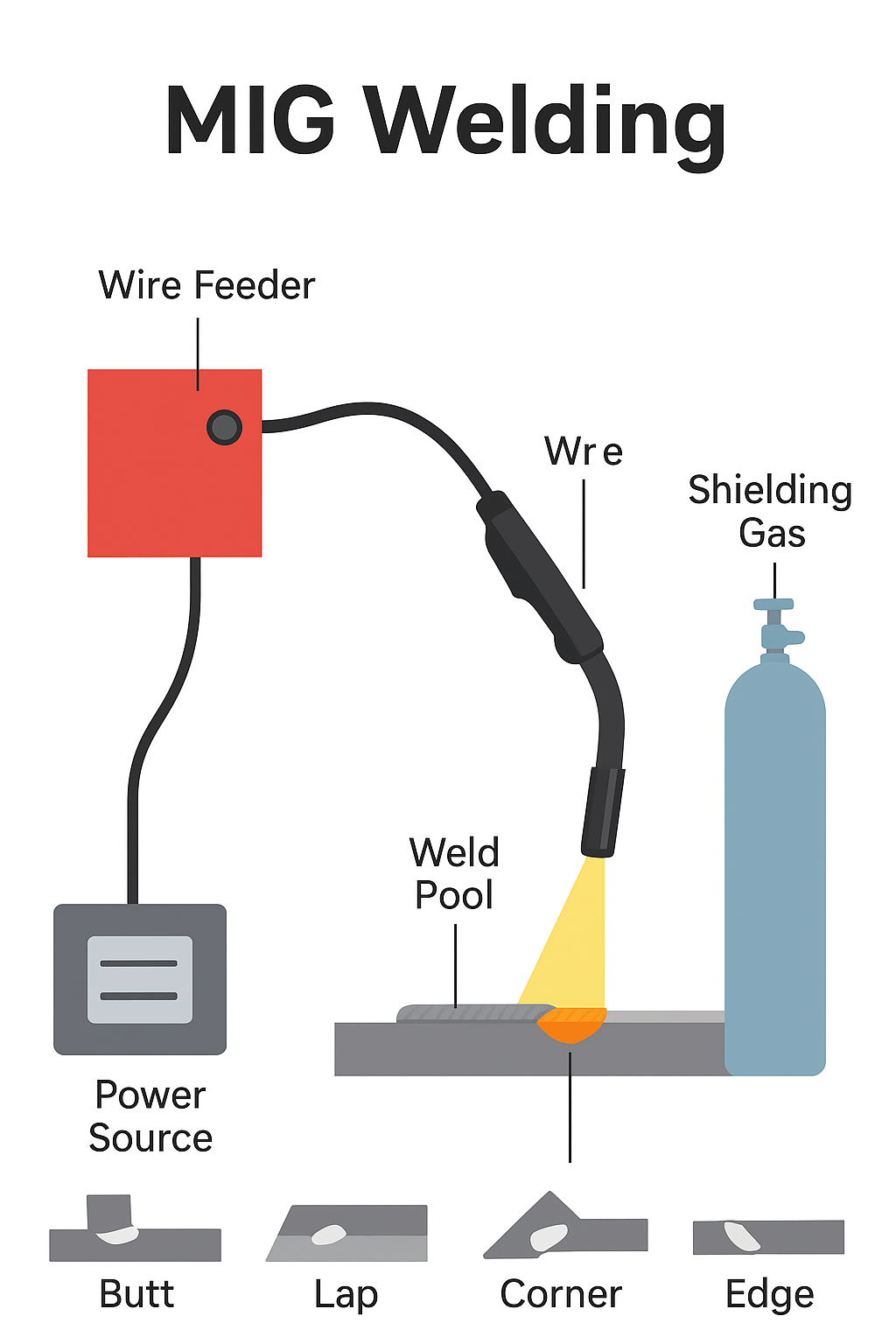
    The MIG process relies on four main components working together:

    1. Power Source

    The machine provides a constant voltage, usually DC+, which stabilizes the arc and ensures consistent deposition.

    2. Wire Feeder

    A motorized wire feeder pushes welding wire through the MIG gun at a controlled, adjustable speed.
    The wire acts as:

    • Filler material
    • Electrode

    3. MIG Gun

    The MIG gun delivers:

    • The wire electrode
    • Electrical current
    • Shielding gas

    A trigger controls the wire feed and arc initiation.

    4. Shielding Gas

    A blend of gases protects the weld pool from atmospheric contamination.
    Common gases include:

    • C25 (75% Argon, 25% CO₂) – Most common for mild steel
    • 100% CO₂ – Deep penetration, more spatter
    • 100% Argon – Aluminum and non-ferrous metals
    • Argon/Helium Mixes – Stainless steel and specialty metals

    The shielding gas is crucial—without it, the weld suffers from porosity, poor fusion, and contamination.


    Advantages: MIG Welding

    MIG welding offers several benefits, making it popular across industries:

    ✔ Fast welding speeds

    Perfect for production and fabrication shops.

    ✔ Easy for beginners to learn

    MIG is more forgiving and easier to control than TIG or stick welding.

    ✔ Versatile across many metals

    MIG works on:

    ✔ Clean weld appearance

    Minimal cleanup is needed due to reduced spatter.

    ✔ Excellent for both thin and thick materials

    Adjustable heat control makes MIG suitable for materials from 24 gauge sheet metal to heavy structural steel.


    Common MIG Welding Wire Types

    Choosing the right wire is essential for a strong, clean weld. The most common wires include:

    1. ER70S-6 (Mild Steel Wire)

    • The most popular MIG welding wire
    • Great for rusty or dirty steel
    • Produces a strong, ductile weld
    • Works well with C25 gas

    Ideal for fabrication, construction, automotive, pipelines, and general repairs.


    2. ER308L / ER309L (Stainless Steel Wire)

    Used for:

    Provides excellent corrosion resistance.


    3. ER4043 & ER5356 (Aluminum MIG Wire)

    ER4043: Smooth bead appearance, great for cast aluminum
    ER5356: Higher strength, used for marine and structural aluminum

    Requires:

    • 100% Argon
    • Spool gun or push-pull system

    4. Flux-Core MIG Wire (FCAW)

    No shielding gas required, making it ideal for:

    • Outdoor work
    • Windy conditions
    • Heavy structural welding

    Produces deeper penetration but more spatter.


    Best Practices for MIG Welding

    For high-quality results, welders follow proven techniques and machine setups.

    1. Set the Correct Voltage & Wire Speed

    Voltage controls arc length.
    Wire speed controls deposition rate.

    Too much voltage → excess spatter
    Too little voltage → unstable arc


    2. Maintain Proper Stick-Out

    Correct MIG stick-out is ⅜”–½”.
    Too long reduces penetration; too short causes excessive heat.


    3. Use the Right Travel Angle

    • Push angle (10–15°) → flatter, cleaner weld
    • Pull angle → deeper penetration

    Most MIG applications use a push technique.


    4. Correct Work Angle

    • 90° for flat joints
    • Adjust 5–15° to prevent undercut or overlap

    5. Keep Your Welding Area Clean

    Remove:

    • Rust
    • Paint
    • Grease
    • Moisture

    You’ll get better penetration and fewer weld defects.


    6. Optimize Shielding Gas Flow

    Typical flow rate: 20–30 CFH.

    Too low → porosity
    Too high → turbulence and contamination


    7. Choose the Right Joint Preparation

    Common MIG joint types include:

    • Butt joints
    • Fillet joints
    • Lap joints
    • T-joints
    • Edge joints

    Correct beveling improves penetration on thicker materials.


    8. Maintain Equipment

    Clean your:

    • Contact tips
    • Wire drive rollers
    • Liners
    • Nozzle

    This reduces feeding issues and improves arc stability.


    Common Applications of MIG Welding

    MIG welding is used in nearly every metalworking industry due to its speed and simplicity.

    🏭 Industrial Fabrication

    Structural steel, frames, platforms, catwalks, brackets, and custom steel components.

    🔧 Automotive Repair

    Body panels, exhaust systems, brackets, aluminum components, and trailer repair.

    🚜 Heavy Equipment Welding

    Buckets, blades, trailer frames, skid steer attachments, and wear plating.

    🏗️ Construction

    Handrails, beams, steel structures, gates, stairs, and on-site steel fabrication.

    🛠 Manufacturing

    High-volume production lines rely on MIG welding for its speed and consistency.

    🚚 Aluminum Repair & Fabrication

    Fuel tanks, boxes, decks, frames, and trailer components.

    🧰 General Metal Repair

    MIG welding is ideal for hobbyists and professionals repairing:

    • Cracked steel
    • Broken brackets
    • Damaged frames
    • Farm equipment

    Why MIG Welding Is a Preferred Choice for Professionals

    Professional welders and fabrication companies prefer MIG welding because it offers:

    • High productivity
    • Clean, consistent welds
    • Minimal cleanup
    • Adaptability for all skill levels
    • Reliability across most metals and environments

    From fabrication to repair work, MIG welding remains an essential tool for delivering strong, dependable welds with maximum efficiency.


    Final Thoughts: Why MIG Welding Matters

    Whether you’re repairing heavy equipment, fabricating new steel structures, or working with aluminum, MIG welding offers unmatched speed, versatility, and performance. With the right wire, gas, settings, and technique, MIG welding produces durable welds suitable for nearly every industry.

    Read more

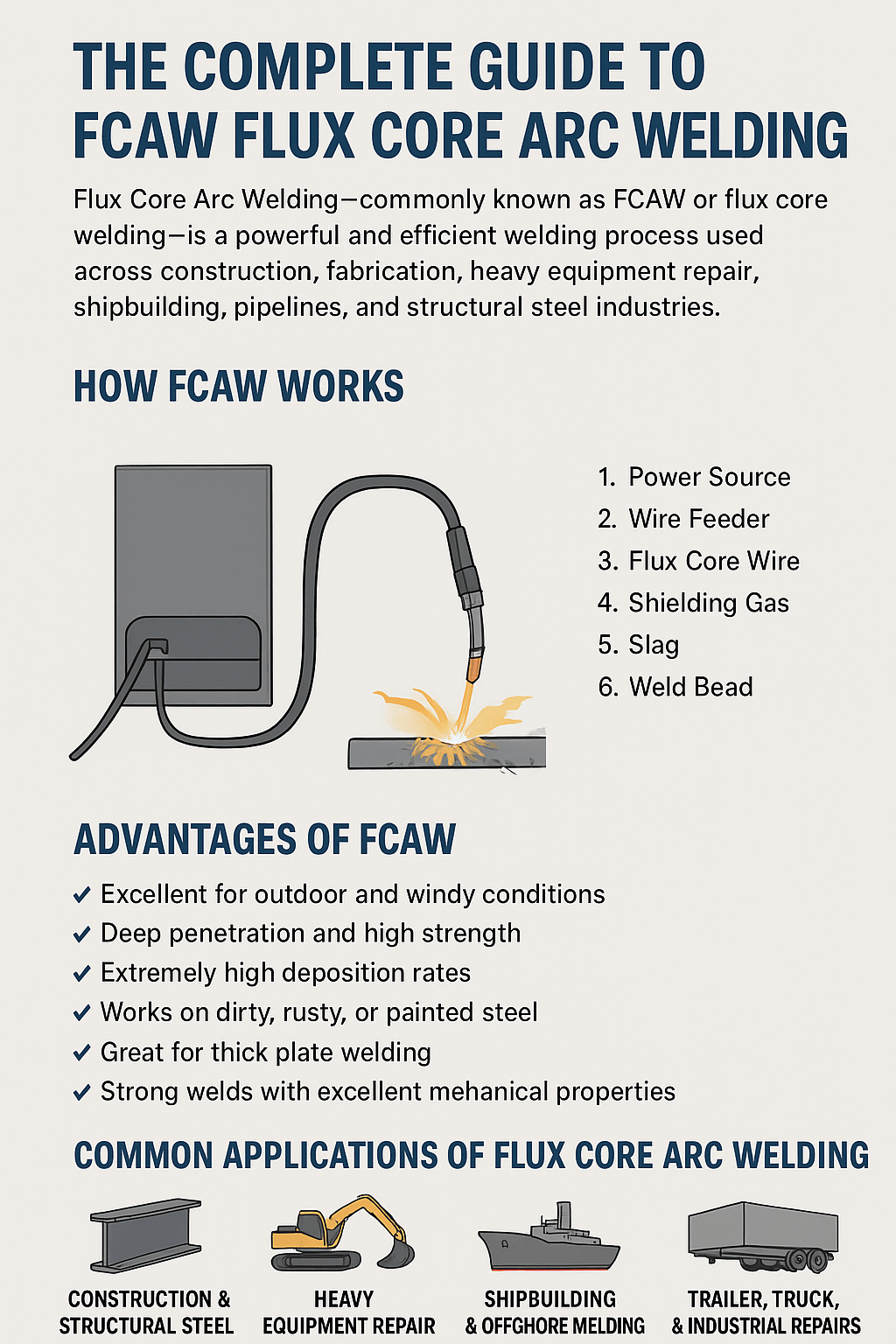
    A Guide to FCAW Flux Core Arc Welding: How It Works, Best Practices, Wire Types, and Common Applications

    Flux Core Arc Welding—commonly known as FCAW or flux core welding—is one of the most powerful and efficient welding processes used across construction, fabrication, heavy equipment repair, shipbuilding, pipelines, and structural steel industries. Known for its high penetration, deep fusion, and ability to weld outdoors in windy conditions, FCAW is a top choice for welders who demand strong, durable welds even in challenging environments.

    In this comprehensive guide, we break down everything you need to know about FCAW, including how the process works, the different types of flux-core wire, ideal applications, machine setup, and best practices used by certified red seal welding professionals.


    What Is FCAW (Flux Core Arc Welding)?

    Flux Core Arc Welding (FCAW) is a semi-automatic welding process that uses a continuously fed consumable wire containing a flux compound in its core. The flux reacts under heat to create shielding gases and slag, protecting the weld from contamination.

    FCAW is similar to MIG welding, except FCAW uses flux-filled wire instead of solid wire and can be used with or without external shielding gas:

    FCAW-S (Self-Shielded)

    • No external gas tank needed
    • Ideal for outdoor, windy, and mobile welding
    • Strong penetration for structural work

    FCAW-G (Gas-Shielded)

    • Uses external shielding gas
    • Produces cleaner welds with less spatter
    • Preferred for indoor fabrication and manufacturing

    This flexibility makes FCAW one of the most versatile welding processes in heavy-duty industries.


    How Flux Core Welding Works

    The FCAW welding system includes:

    1. Power Source

    Most FCAW uses DC Electrode Negative (DC-) for self-shielded wire and DC Electrode Positive (DC+) for gas-shielded wire.

    DC- provides deeper penetration for structural applications.
    DC+ offers smoother welds and stable arcs.


    2. Wire Feeder

    A motorized feeder pushes flux core wire at a controlled speed, acting as both:

    • The welding electrode
    • The filler metal

    Wire feed speed determines weld deposition and penetration.


    3. Flux Core Wire

    The wire has a hollow center filled with flux that provides:

    • Shielding gas
    • Slag formation
    • Arc stabilization
    • Alloying elements
    • Enhanced weld strength

    The flux is the key difference between FCAW and MIG welding.


    4. Shielding Gas (For FCAW-G Only)

    Common gases include:

    • 100% CO₂ → Deep penetration
    • 75/25 Argon-CO₂ → Cleaner welds, reduced spatter
    • 90/10 Argon-CO₂ (Dual-Shield) → High-performance structural welding

    5. Slag Formation

    As the weld cools, slag forms on top of the weld bead.
    Slag protects the molten weld and must be removed afterward.


    Advantages of FCAW Welding

    FCAW is popular because it offers benefits unmatched by other processes:

    ✔ Excellent for Outdoor and Windy Conditions

    Self-shielded wire produces its own gas cloud—a major advantage over MIG.

    ✔ Deep Penetration and High Strength

    Ideal for structural steel, bridges, heavy equipment, and thick materials.

    ✔ Extremely High Deposition Rates

    FCAW can deposit metal faster than MIG and Stick, increasing productivity.

    ✔ Works on Dirty, Rusty, or Painted Steel

    Flux cleans impurities and ensures strong fusion.

    ✔ Great for Thick Plate Welding

    FCAW is commonly used on materials from 3/16″ to 1″ or thicker.

    ✔ Strong Welds with Excellent Mechanical Properties

    Perfect for critical welding applications.


    Common Flux Core Welding Wire Types

    Choosing the correct wire ensures proper weld strength and quality. The most common FCAW wires include:


    1. E71T-11 (Self-Shielded)

    Most popular FCAW-S wire.
    Benefits:

    • No gas required
    • Great for outdoor welding
    • Good penetration
    • Works in all positions

    Used widely for construction welding, general repairs, and farm equipment.


    2. E71T-1 (Gas-Shielded “Dual Shield”)

    Professional-grade FCAW-G wire for structural fabrication.

    Benefits:

    • High deposition rates
    • Clean, strong welds
    • Minimal spatter
    • Excellent mechanical properties

    Common in fabrication shops, shipbuilding, and heavy steel assembly.


    3. E71T-8 (Structural Self-Shielded Wire)

    Designed for:

    • Thick structural steel
    • Bridges
    • High-rise construction
    • Welds requiring deep penetration

    Provides exceptional strength and reliability.


    4. E70T-4

    Used for:

    • Heavy equipment rebuilding
    • Industrial fabrication
    • Deep joint penetration

    Strong, extremely durable welds but not aesthetically focused.


    5. Specialty Wires

    • Stainless steel flux core wire
    • Hardfacing flux core wire
    • Nickel-alloy flux core wire

    Used for specialty applications like corrosion resistance or abrasion control.


    Best Practices for FCAW Welding

    For clean, strong welds, welders follow these proven techniques.


    1. Maintain Correct Stick-Out

    Flux core stick-out should be 5/8″ to 3/4″ for FCAW-S.

    Too long → weak arc and porosity
    Too short → excessive heat and spatter


    2. Use Proper Travel Angle

    Most FCAW uses a drag (pull) technique at a 10–15° angle.

    Dragging keeps the slag behind the puddle to reduce contamination.


    3. Select the Right Wire Feed Speed

    Wire feed controls penetration.
    Increase if:

    • Arc is sputtering
    • Wire is burning back
    • Weld is sitting too high

    Reduce if:

    • Too much spatter
    • Burn-through occurs
    • Over-penetration appears

    4. Adjust Voltage Correctly

    Voltage controls arc length.

    • Too high: flat, wide beads
    • Too low: narrow, unstable arc

    Correct voltage produces a smooth, steady buzzing arc.


    5. Clean the Base Metal When Possible

    Even though flux core tolerates dirt, performance improves by removing:

    • Rust
    • Oil
    • Paint
    • Moisture

    6. Avoid Overheating the Weld Area

    Flux core welding runs hot—be mindful to prevent:

    • Excess warping
    • Burn-through
    • Excessive slag inclusion

    7. Remove Slag Between Passes

    Slag must be removed with:

    • A chipping hammer
    • A wire brush
    • A grinder (when necessary)

    Slag left behind leads to porosity, inclusions, and weak welds.


    8. Keep Your Machine and Consumables Clean

    • Change contact tips regularly
    • Clean drive rollers
    • Replace worn liners
    • Use knurled rollers for flux-core wire

    Good maintenance ensures reliable feeding and stable arc performance.


    Common Applications of Flux Core Arc Welding

    FCAW is used in some of the world’s toughest industries due to its penetrating power and outdoor capabilities.


    🏗 1. Welding for Construction & Structural Steel

    FCAW is the dominant process for:

    • High-rise buildings
    • Bridges
    • Support beams
    • Columns and girders
    • Heavy structural connections

    E71T-8 and E71T-1 wires are standard for structural codes.


    🛠 2. Heavy Equipment Repair

    Flux core welds are tough and durable—perfect for:

    • Excavator buckets
    • Bulldozer blades
    • Loader arms
    • Wear plates
    • Cracked frames

    Hardfacing flux core wire adds wear resistance.


    🚢 3. Shipbuilding & Offshore Welding

    FCAW is common for:

    • Hull assembly
    • Deck structures
    • Marine-grade steel

    Gas-shielded FCAW-G is preferred for its reliability.


    🛻 4. Trailer, Truck, & Industrial Repairs

    Used for:

    • Box frames
    • Industrial trailers
    • Steel decks
    • Structural reinforcements

    Self-shielded wire handles outdoor repair environments easily.


    🧱 5. Welding and Fabrication Shops

    Dual-shield FCAW-G is the top choice for fabrication because it produces:

    • Clean welds
    • High deposition
    • Strong mechanical properties

    Ideal for large-scale production welding.


    🔧 6. Manufacturing & Production

    Robotics and automated welding frequently use FCAW-G for large volume output.


    Why FCAW Is a Professional Welder’s Go-To Process

    Flux core welding offers:

    • Exceptional strength
    • Fast deposition rates
    • Reliability in bad weather
    • Ability to weld thicker materials
    • Superior penetration

    It’s the ideal combination of power, durability, productivity, and versatility—making FCAW one of the most relied-on welding processes in industrial environments.


    Final Thoughts: FCAW Remains One of the Strongest and Most Reliable Welding Methods

    Whether used on construction sites, in manufacturing facilities, or in heavy equipment repair, Flux Core Arc Welding delivers unmatched performance and strength. Its ability to handle dirty metal, weld outdoors, and penetrate thick steel makes it indispensable to welders who need results that last.

    Read more
    Verified by MonsterInsights