
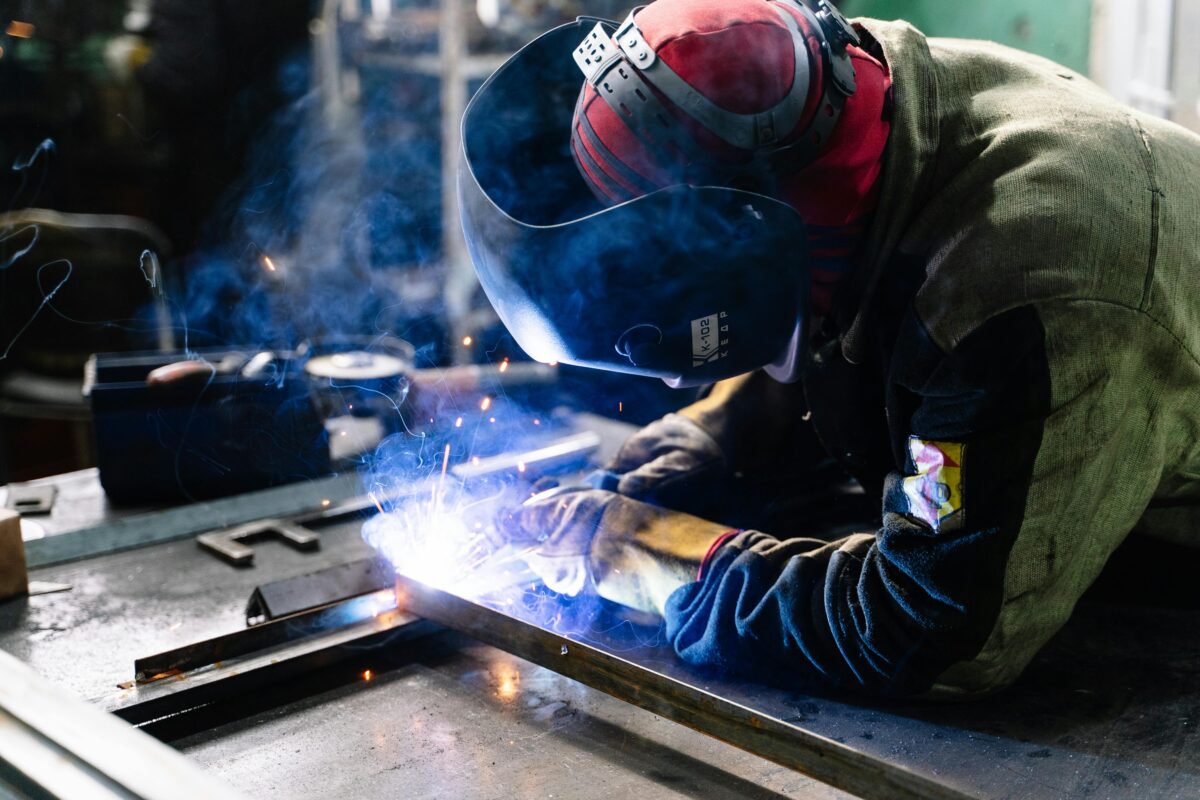
MIG welding—also known as Gas Metal Arc Welding (GMAW)—is one of the most widely used welding processes in both industrial and commercial environments. Known for its speed, versatility, efficiency, and consistent weld quality, MIG welding is a go-to method for fabrication projects, automotive repair, construction, equipment repair, and general manufacturing.
In this in-depth guide, we break down how MIG welding works, the equipment involved, wire types, best practices, and the industries that rely on MIG welding every day. Whether you’re a beginner, a professional welder, or a business owner researching welding services, this article covers everything you need to know.
What Is MIG Welding?
MIG (Metal Inert Gas) welding is a welding process where a spool-fed wire electrode is continuously fed through a welding gun, where it melts and fuses the metal surfaces together. Unlike stick welding, which uses a consumable electrode rod, MIG welding uses a wire and shielding gas to protect the weld from contamination.
This results in:
- Clean, smooth welds
- Faster travel speeds
- Less spatter
- Minimal welding fumes
- Easier learning curve for beginners
Because of its efficiency and adaptability, MIG welding is one of the most commonly used welding methods worldwide.
How MIG Welding Works
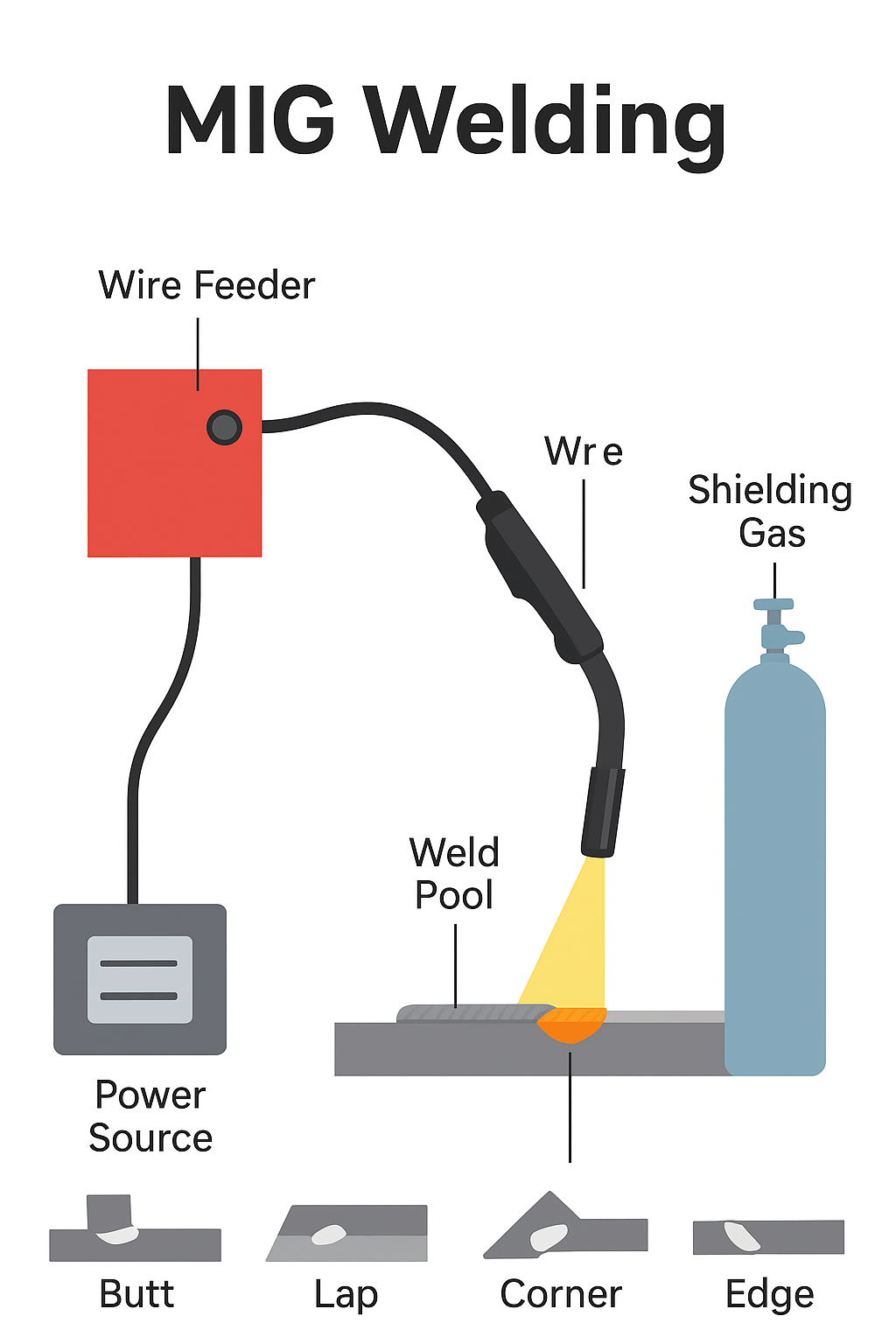
The MIG process relies on four main components working together:
1. Power Source
The machine provides a constant voltage, usually DC+, which stabilizes the arc and ensures consistent deposition.
2. Wire Feeder
A motorized wire feeder pushes welding wire through the MIG gun at a controlled, adjustable speed.
The wire acts as:
- Filler material
- Electrode
3. MIG Gun
The MIG gun delivers:
- The wire electrode
- Electrical current
- Shielding gas
A trigger controls the wire feed and arc initiation.
4. Shielding Gas
A blend of gases protects the weld pool from atmospheric contamination.
Common gases include:
- C25 (75% Argon, 25% CO₂) – Most common for mild steel
- 100% CO₂ – Deep penetration, more spatter
- 100% Argon – Aluminum and non-ferrous metals
- Argon/Helium Mixes – Stainless steel and specialty metals
The shielding gas is crucial—without it, the weld suffers from porosity, poor fusion, and contamination.
Advantages: MIG Welding
MIG welding offers several benefits, making it popular across industries:
✔ Fast welding speeds
Perfect for production and fabrication shops.
✔ Easy for beginners to learn
MIG is more forgiving and easier to control than TIG or stick welding.
✔ Versatile across many metals
MIG works on:
- Mild steel
- Stainless steel
- Aluminum
- Nickel alloys
- Some copper alloys
✔ Clean weld appearance
Minimal cleanup is needed due to reduced spatter.
✔ Excellent for both thin and thick materials
Adjustable heat control makes MIG suitable for materials from 24 gauge sheet metal to heavy structural steel.
Common MIG Welding Wire Types
Choosing the right wire is essential for a strong, clean weld. The most common wires include:
1. ER70S-6 (Mild Steel Wire)
- The most popular MIG welding wire
- Great for rusty or dirty steel
- Produces a strong, ductile weld
- Works well with C25 gas
Ideal for fabrication, construction, automotive, pipelines, and general repairs.
2. ER308L / ER309L (Stainless Steel Wire)
Used for:
- Stainless railings
- Food-grade equipment
- Chemical processing components
Provides excellent corrosion resistance.
3. ER4043 & ER5356 (Aluminum MIG Wire)
ER4043: Smooth bead appearance, great for cast aluminum
ER5356: Higher strength, used for marine and structural aluminum
Requires:
- 100% Argon
- Spool gun or push-pull system
4. Flux-Core MIG Wire (FCAW)
No shielding gas required, making it ideal for:
- Outdoor work
- Windy conditions
- Heavy structural welding
Produces deeper penetration but more spatter.
Best Practices for MIG Welding
For high-quality results, welders follow proven techniques and machine setups.
1. Set the Correct Voltage & Wire Speed
Voltage controls arc length.
Wire speed controls deposition rate.
Too much voltage → excess spatter
Too little voltage → unstable arc
2. Maintain Proper Stick-Out
Correct MIG stick-out is ⅜”–½”.
Too long reduces penetration; too short causes excessive heat.
3. Use the Right Travel Angle
- Push angle (10–15°) → flatter, cleaner weld
- Pull angle → deeper penetration
Most MIG applications use a push technique.
4. Correct Work Angle
- 90° for flat joints
- Adjust 5–15° to prevent undercut or overlap
5. Keep Your Welding Area Clean
Remove:
- Rust
- Paint
- Grease
- Moisture
You’ll get better penetration and fewer weld defects.
6. Optimize Shielding Gas Flow
Typical flow rate: 20–30 CFH.
Too low → porosity
Too high → turbulence and contamination
7. Choose the Right Joint Preparation
Common MIG joint types include:
- Butt joints
- Fillet joints
- Lap joints
- T-joints
- Edge joints
Correct beveling improves penetration on thicker materials.
8. Maintain Equipment
Clean your:
- Contact tips
- Wire drive rollers
- Liners
- Nozzle
This reduces feeding issues and improves arc stability.
Common Applications of MIG Welding
MIG welding is used in nearly every metalworking industry due to its speed and simplicity.
🏭 Industrial Fabrication
Structural steel, frames, platforms, catwalks, brackets, and custom steel components.
🔧 Automotive Repair
Body panels, exhaust systems, brackets, aluminum components, and trailer repair.
🚜 Heavy Equipment Welding
Buckets, blades, trailer frames, skid steer attachments, and wear plating.
🏗️ Construction
Handrails, beams, steel structures, gates, stairs, and on-site steel fabrication.
🛠 Manufacturing
High-volume production lines rely on MIG welding for its speed and consistency.
🚚 Aluminum Repair & Fabrication
Fuel tanks, boxes, decks, frames, and trailer components.
🧰 General Metal Repair
MIG welding is ideal for hobbyists and professionals repairing:
- Cracked steel
- Broken brackets
- Damaged frames
- Farm equipment
Why MIG Welding Is a Preferred Choice for Professionals
Professional welders and fabrication companies prefer MIG welding because it offers:
- High productivity
- Clean, consistent welds
- Minimal cleanup
- Adaptability for all skill levels
- Reliability across most metals and environments
From fabrication to repair work, MIG welding remains an essential tool for delivering strong, dependable welds with maximum efficiency.
Final Thoughts: Why MIG Welding Matters
Whether you’re repairing heavy equipment, fabricating new steel structures, or working with aluminum, MIG welding offers unmatched speed, versatility, and performance. With the right wire, gas, settings, and technique, MIG welding produces durable welds suitable for nearly every industry.